Garbage Disposal Humming But Not Working
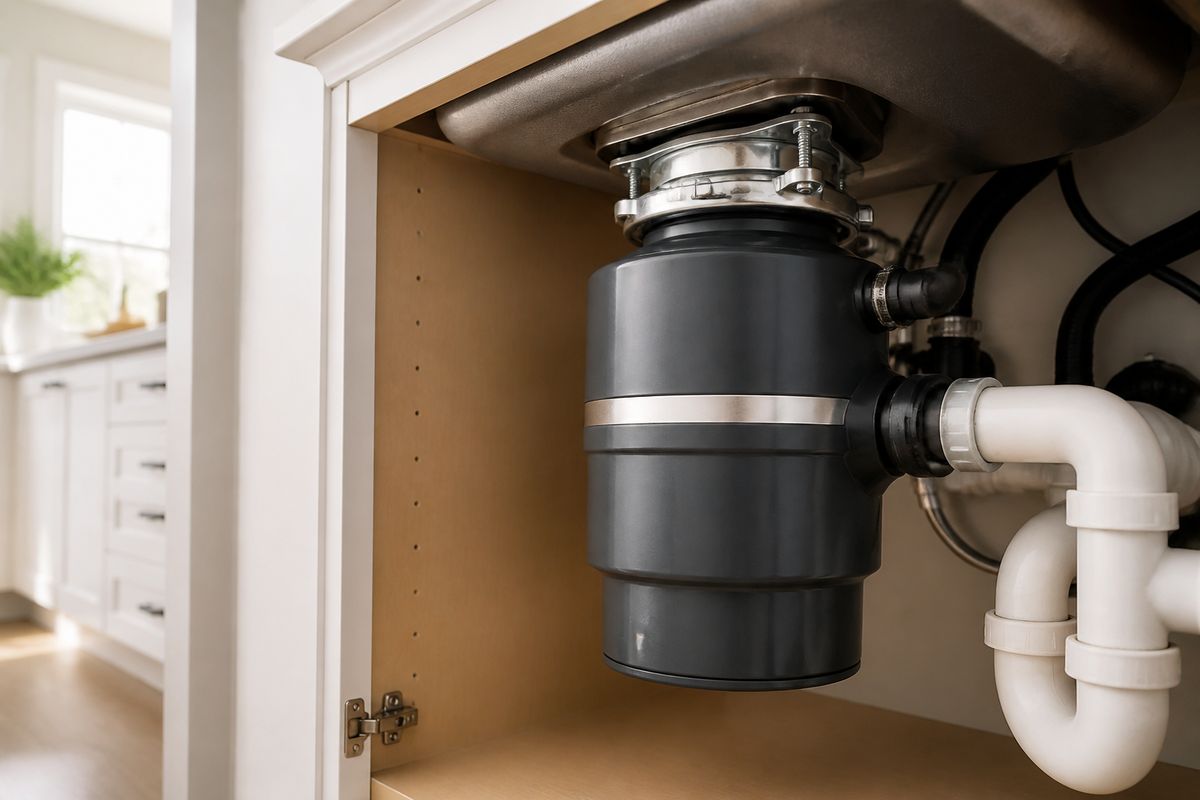
If your sink suddenly stops draining and you hear garbage disposal humming but not working, you’re probably dealing with a motor that has power but can’t rotate the grind chamber. The sound is a big clue: the unit is trying, but something is blocking movement or preventing proper electrical operation. The right fix depends on whether the cause is mechanical (a jam) or electrical (power, switch, or motor failure).
For more help, see our GE Garbage Disposal Not Working: Diagnose Every Common Cause guide.
What the humming means
Why the unit hums but the impellers don’t turn
A humming garbage disposal that won’t spin almost always means the motor is energized, but the internal impeller/drive plate can’t move. The most common cause is a jam: a blade is stuck against food debris, a utensil, or compacted grease and particles. Another mechanical cause is a seized flywheel/impeller from corrosion or dried material.
Less commonly, the disposal can hum due to an electrical fault where the motor circuit engages but the motor can’t reach full rotation. That can include a tripped safety reset, a failed capacitor, or damaged wiring. The key is to move from “what it sounds like” to “what it does” once power is safely handled.
Signs of a jam versus an electrical fault
Use behavior to separate mechanical from electrical problems:
- Jam signs: humming continues immediately after turning on; nothing grinds; you may hear a brief change in tone when switching on; the unit often “feels stuck” when you attempt to manually free the flywheel (with power off).
- Electrical fault signs: no hum at all (dead) or intermittent hum with a tripping breaker; repeated tripping after resets; you hear a buzz but the motor never attempts to turn; a burning smell or scorch marks around the switch/outlet.
If you see standing water in the sink and the disposal hums but won’t rotate, start with the jam pathway first—mechanical blockage is the fastest, most common fix.
When loud grinding or clunking means a different problem
Not all “not working” situations sound the same. Loud grinding, scraping, or loud clunking usually points to physical interference rather than a simple jam.
Common causes include:
- Loose mounting hardware causing the unit to shift and hit nearby parts.
- Worn impellers or a damaged grind ring that knocks under load.
- Debris impact—bottle caps, bones, fruit pits, or small metal objects striking the chamber.
If the noise is severe, stop using the unit and clear the chamber. Continued operation can damage impeller blades, bearings, or the motor housing, turning a quick fix into a replacement.
Safety first before troubleshooting
Cut power at the wall and breaker
Start with full power isolation before touching any reset button, tools, or the underside of the unit.
- Switch off power at the wall switch.
- Turn off the disposal breaker in the electrical panel (flip the correct breaker to OFF).
- If you’re not sure which breaker feeds the outlet, shut off power to that entire circuit—then confirm the switch no longer energizes the disposal by attempting to turn it on (with the wall switch only) after power is off at the panel.
Never trust just the wall switch. Disposals have safety components inside, and accidental re-energizing is a common cause of injuries during jam clearing.
Check for standing water and hidden obstructions
Standing water means the disposal isn’t draining the chamber or the plumbing run. Before attempting any release, clear the obvious mess so you can access the drain opening and see what’s blocking flow.
- Remove as much water as possible using a cup/small bucket.
- Use a flashlight to look down into the drain opening for visible items.
- If you find debris near the top, remove it with tongs or pliers—not your hands.
If you have a dishwasher, check that it isn’t pushing a clog into the disposal. A blocked dishwasher drain line can overload the disposal’s inlet and contribute to a jam or noise.
What to avoid putting your hands or tools into
Never reach into the grind chamber. Fingers and tools can slip, and the impeller can shift unexpectedly when power is restored (or if the safety system resets).
- Do not put your hand into the grind chamber, even with the switch off.
- Do not use a screwdriver tip or metal rod directly inside the chamber to “pry” unknown objects.
- Only use the disposal’s designed jam-release point (for many models, a hex socket under the unit) with power off.
Dropped metal objects are the most common jam cause. Use tongs/pliers to retrieve accessible items, then move to the proper flywheel release procedure.
Simple fixes that solve most humming disposals
Use the reset button the right way
The reset button is designed to restart the unit after an overload or thermal trip. Use it after you ensure power is safe and any jam risk is addressed.
- Cut power at the breaker.
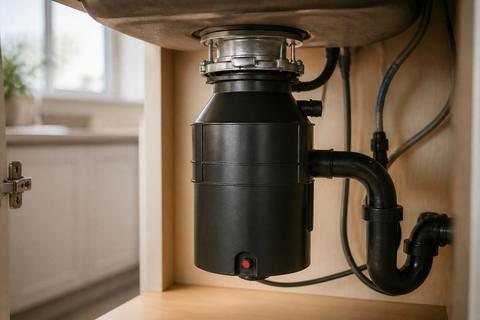
- Locate the red overload/reset button on the bottom of the motor housing.
- Press the button in firmly until it clicks (do not “hold it” indefinitely).
- Restore power and try the wall switch.
If the disposal hums again immediately, the reset did not solve a mechanical jam. In that case, go straight to flywheel release with the hex key.
Free a jam with the hex key under the unit
If the disposal hums but doesn’t rotate, use the mechanical jam-release method.
- Turn off power at the breaker and wall switch.
- Insert a 1/4-inch hex (Allen) wrench into the hex socket in the center of the unit’s underside.
- Work the wrench back and forth and rotate through a full movement to free the impeller plate.
- Remove the wrench, then press the red reset button until it clicks.
- Turn on the switch to verify normal spinning and grinding.
This method clears stuck blades caused by compacted waste or small obstructions trapped in the grind path.
Manually rotate the flywheel to clear a stuck blade
Some jams create enough resistance that pressing reset alone fails. Manual rotation frees a stuck blade so the motor can start under load.
- With power OFF at the breaker, use the hex wrench in the underside socket.
- Rotate slowly, changing direction if you feel resistance, until the flywheel moves more freely.
- If the wrench will not rotate at all, remove visible debris first—do not force the mechanism.
- Once rotation is possible, press the reset button (red overload) until it clicks and retry.
Manual rotation is the most reliable mechanical step when the disposal is humming continuously but not turning.
Remove visible debris from the drain opening
Visible debris is the quickest win and prevents you from repeatedly resetting a jam.
- Turn off the breaker.
- Shine a flashlight into the drain opening.
- Remove items you can reach with tongs or pliers—especially metal, bottle caps, and fruit pits.
- If the obstruction is near the top, pull it out carefully and avoid pushing it deeper.
- After removal, press the reset button and try the disposal.
If you don’t see anything visible and it still hums but won’t spin, the blockage is likely deeper and needs flywheel jam release.
If it hums but still will not run
Confirm the outlet, switch, and breaker are working
Before assuming the motor is dead, verify the power path. A bad outlet, faulty wall switch, or incorrect breaker can cause abnormal behavior such as hum without full startup.
- With breaker ON, check that the wall switch fully sends power—toggle it firmly.
- Confirm the breaker feeding the disposal is set to ON and not tripped again.
- If available, test the disposal outlet voltage with a multimeter or use an outlet tester near the connection (turn power off first, follow tool instructions).
- If the wall switch is part of a shared circuit, confirm that other loads aren’t causing a trip.
If power is confirmed but rotation still fails, the issue moves inside the motor assembly.
Look for a seized motor or failed capacitor
When a disposal hums but nothing moves after jam-free checks, the motor may be seized internally or the start capacitor may have failed.
- If you performed the hex wrench jam release and reset, but it hums immediately without turning, treat the motor as the likely problem.
- Check for signs of overheating: discoloration, scorch marks, or a persistent burnt smell.
- In many disposals, capacitor failure can allow a buzz/hum but prevent the motor from reaching rotation.
This is where diagnosis may require opening the unit and measuring components. If you’re not comfortable with electrical testing, call a licensed plumber/electrician.
Test for a disposal that is humming but nothing is stuck
If you cleared the chamber and the flywheel rotates freely, use a controlled check:
- Turn off power at the breaker.
- Remove any remaining visible debris and ensure nothing is lodged at the drain throat.
- Press the red reset button and restore power.
- Turn on the disposal and observe: does it spin up, or does it hum and stop with no rotation?
If it hums but never spins despite free rotation attempts, mechanical obstruction is unlikely, and electrical failure becomes more probable.
Know when the motor has likely burned out
A burned-out motor is the point where resets won’t bring the unit back. Motor failure commonly presents as repeated hum attempts with no rotation, plus heat damage indicators.
- If the disposal hums once, doesn’t rotate, and keeps failing even after you press reset, motor failure is likely.
- If you smell burning or see darkened wiring/motor insulation, stop troubleshooting—continue attempts can cause further damage.
- If the breaker trips every time you attempt startup, the internal overload protection may be doing its job due to motor issues.
At this stage, replacement is often the realistic route, especially for older units.
When noise points to wear, damage, or replacement
Loose parts, worn bearings, and metal-on-metal sounds
Humming is one thing; grinding and knocking often point to wear or damage. Loose parts and worn bearings can create repetitive scraping or rattling even when the disposal is able to spin.
- If noise sounds like metal-on-metal scraping, stop immediately; that can indicate internal contact.
- If the unit rattles during startup and then quiets, it can be mounting hardware or debris.
- If vibration persists while grinding, bearings or internal impellers may be worn.
Wear noise gets worse with use and can lead to seized components that restart failures after resets.
Vibration, rattling, and sink or mounting issues
A disposal that shakes the sink or rattles the cabinet often has a mounting problem rather than a pure internal jam.
- Check for looseness at the mounting ring or under-sink connections.
- Confirm the dishwasher/disposal discharge routing isn’t causing strain or misalignment.
- Look for gaps between the disposal and sink flange; a loose mount can cause vibration-driven noise.
If vibration is strong, don’t keep running it. Vibration can damage seals and eventually contribute to leaks.
How to tell a noisy disposal from a failing one
Not all noise is a failure, but some patterns signal that the unit needs replacement.
- Noise without failure: mild rattling that clears after debris removal and the disposal spins normally.
- Likely failing: loud clunking, scraping that returns every cycle, and hum/no-spin after repeated resets.
- Concerning symptoms: increasing vibration, recurrent jamming, leaks around the flange, or a smell of overheating.
When noise and failure symptoms overlap, prioritize replacement over repeated troubleshooting—especially if the unit is older.
How to keep the problem from coming back
What foods and objects commonly cause jams
Jams usually come from items that don’t break down well or build up into compact masses.
- Fibrous foods: corn husks, celery strings, artichoke leaves—these can wrap and stall rotation.
- Starchy waste and large volumes of rice or pasta—can paste up and clog the chamber.
- Grease and fat: pour-off grease solidifies and traps other debris.
- Hard or non-food objects: bottle caps, bones, fruit pits, and utensils.
Run cold water and grind small amounts at a time so the waste flushes through instead of packing into corners.
Best habits for quiet, reliable operation
Good habits reduce both jams and wear on impellers.
- Use running water during disposal use; keep water on for a short time after grinding.
- Feed waste gradually instead of dumping a full pot at once.
- Alternate between watery waste (like rinsed scraps) and solids to help flush material through.
- Avoid oversized chunks—cut large scraps into smaller pieces.
If your dishwasher connects to the disposal, ensure the dishwasher knockout plug is correctly removed during installation to prevent drainage backflow into the unit’s chamber.
When a disposal upgrade makes more sense than repair
If you repeatedly deal with jamming or noise and you’re paying for recurring labor, an upgrade can be cheaper than continued repairs.
- If your disposal is very old and frequently hums, trips reset, or requires manual flywheel freeing, replacement is often the best value.
- If the unit is leaking—especially from the bottom housing or internal seals—repairing it is rarely practical; replacement is typically required.
- If you have frequent dishwasher backups, you may need a properly sized model and correct plumbing configuration.
Newer disposals also handle modern kitchen usage more efficiently and run quieter.
When to call a plumber or replace the unit
Repeated resets and recurring jams
Call a plumber if the disposal keeps needing resets or jams shortly after clearing. A pattern indicates deeper mechanical wear, persistent obstruction in the drain path, or internal failures that manual clearing can’t fix permanently.
- If pressing reset restores function briefly, then the unit hums and stops again, schedule service.
- If you must clear the flywheel repeatedly within weeks, internal damage may be forming.
- If the clog is actually in the drain line below the disposal, a plumber can address it without repeated disposal cycling.
Continuously resetting a struggling disposal can worsen internal damage.
Water leaks, tripped breakers, or burning smells
Stop DIY attempts and contact a plumber immediately when you see safety red flags.
- If you notice water leaking at the sink flange, the plumber’s putty seal or mounting ring may have loosened.
- If water drips from the bottom housing, an internal seal likely failed—replacement is usually required.
- If the breaker trips repeatedly or you smell burning/scorched insulation, the motor or wiring may be damaged and unsafe to keep trying.
Electrical and leak issues can escalate quickly and create water damage or fire risk.
Age, noise level, and repair cost as replacement signals
Use these signals to decide between repair and replacement.
- If the unit is older and now produces severe noise (scraping/clunking) plus startup failures, replacement is more cost-effective.
- If repair estimates approach the price difference of a new disposal installed, replacement wins.
- If the disposal frequently jams due to wear and doesn’t perform normally even after jam clearing, internal parts may be too damaged to justify labor.
When noise and reliability problems stack up, replacement is the practical solution.
Frequently Asked Questions
Why is my garbage disposal humming but not working?
Most often the motor is getting power but the grinding plate is jammed. Less commonly, the reset button, switch, wiring, or motor itself has failed.
How do I fix a garbage disposal that just hums?
Turn off power, press the reset button, then use the hex key to free the flywheel if the unit is jammed. If it still only hums, check the power source and consider a motor failure.
What if my garbage disposal hums when turned on but nothing is stuck?
A humming unit with no visible obstruction can still have a seized motor, damaged capacitor, or internal wear that prevents rotation. At that point, electrical diagnosis or replacement may be needed.
Why is my garbage disposal so loud or making clunking noises?
Loud noise can come from loose mounting hardware, worn internal parts, damaged impellers, or debris hitting the grind chamber. Continued operation can make the damage worse.
Does a reset button fix every humming disposal?
No. The reset button helps if the motor overheated or tripped a safety feature, but it will not clear a mechanical jam or repair a failed motor.
When should I replace a noisy or humming garbage disposal?
If the unit keeps jamming, trips repeatedly, leaks, smells burnt, or is very old and loud, replacement is often more cost-effective than repair.